FIND YOUR SCOTTISH CLAN

A New Englander’s Guide to Clans, Tartans & Scottish Ancestry
How to trace your Scottish roots, identify a possible clan or sept, find your tartan, and connect with clan societies here in New England
By Larry Bethune, Editor-in-Chief, Scots in New England
Perhaps your grandmother told you that the family was Scottish. Maybe you have a MacDonald, Campbell, Fraser, Stewart or Murray somewhere in the family tree. Perhaps there is an old tartan scarf tucked away in a drawer—or simply a family story that begins, “We came from Scotland.”
Sooner or later, many people of Scottish descent ask the same question:
What is my clan?
It sounds like a simple question. Sometimes it is. Sometimes it opens the door to a wonderful detective story involving surnames, old records, migrations, tartans, Highland history and relatives you never knew you had.
And here in New England, discovering your clan doesn’t have to end with finding a name on a family tree. You may be able to meet members of your clan, visit its tent at a Highland Games, join its clan association, learn its history and become part of a living Scottish community.
Here is how to get started.
First: What Exactly Is a Scottish Clan?
The Gaelic word clann means “children” or “descendants,” but the historic Scottish clan was considerably more complicated than one enormous biological family.
Clans developed as communities of families connected by kinship, territory, allegiance and protection, generally associated with a chief. Over centuries they could include relatives of the chief, branches of the principal family, allied families, tenants, dependents and others who lived under the clan’s protection.
That is important because not everyone historically associated with a clan necessarily descended from one common male ancestor.
The Standing Council of Scottish Chiefs describes clans as kinship groups but also cautions against romanticizing the system: Scotland has always had many distinguished families and surnames that were not clans at all.
So your objective should not be to force your family into a clan. It should be to discover where your Scottish family actually leads you.
1. Start With Your Own Family—Not a Clan List
It is tempting to type your surname into an online “Find Your Clan” website and declare the mystery solved.
Don’t start there.
Start with your parents, grandparents and great-grandparents.
Write down what you know:
- Names, including women’s maiden names
- Birth, marriage and death dates
- Places where they lived
- Religious affiliations
- Immigration dates
- Family stories about Scotland
- Old photographs, Bibles, letters and certificates
- Scottish place names mentioned by older relatives
Your first objective is not yet to identify a clan.
It is to identify the ancestor who actually came from Scotland.
That distinction matters. A surname can suggest a direction for research, but by itself it does not prove clan ancestry.
2. Trace Your Family Back to Scotland
Once you identify a likely Scottish ancestor, work backward one generation at a time.
One of the most important resources is Scotland’s People, the official Scottish genealogy website operated by National Records of Scotland.
Its collections include Scottish civil registrations of births, marriages and deaths beginning in 1855, church registers reaching back into the 1500s, census records beginning in 1841, wills, valuation rolls and many other historical records.
A remarkably useful Scottish death certificate, for example, may identify the deceased person’s parents—including the mother’s maiden name—allowing you to jump back another generation.
The basic rule of good genealogy is simple:
Begin with what you know and work backward.
Don’t begin with a famous Highland chief and try to work forward until you find yourself.
Scots in New England also maintains our own growing Scottish Genealogy section with articles and resources intended to help New Englanders explore their Scottish roots.
A good first goal
Try to establish this chain:
You → Parent → Grandparent → Great-grandparent → Scottish immigrant → Parents in Scotland → Scottish parish or town
Finding the place in Scotland can sometimes be just as important as finding the surname.
3. Now Ask: Is My Surname Associated With a Clan?
Once you have documented Scottish ancestors, begin investigating their surnames.
Some connections will be obvious. Others won’t be.
And this is where you should proceed carefully.
There are hundreds of active Scottish clan and family organizations. One particularly useful starting point is the Clan Campbell Society’s directory of Scottish clan and family associations, which currently lists more than 300 organizations.
You can also consult the Standing Council of Scottish Chiefs, particularly when determining whether a clan or family currently has a recognized chief.
But don’t assume that because a commercial website associates your surname with Clan X, the matter is settled.
Check with the clan organization itself.
4. What Is a “Sept”—and Is My Name One?
This may be one of the most misunderstood subjects in Scottish genealogy.
You will frequently encounter statements such as:
“Smith is a sept of Clan X.”
Treat such claims as a clue to investigate, not genealogical proof.
The Standing Council of Scottish Chiefs makes an especially important point: there is no single official list of recognized Scottish septs. Recognition of names associated with a clan is a matter for the individual chief.
Historical relationships between families could arise through marriage, geography, service, protection, political allegiance and other circumstances.
Consequently, if a website says your surname is a sept of a particular clan, take the next step:
Contact that clan’s recognized organization and ask why the surname is associated with the clan.
Even better, compare that tradition with your genealogy and the part of Scotland where your ancestors lived.
That turns an internet claim into historical research.
5. Do I Have to Prove That I Am Related to the Chief?
Usually, no.
This is one of the most encouraging things for newcomers to discover.
You should distinguish between belonging historically to a clan or family and joining a modern clan society or association.
They aren’t exactly the same thing.
The Standing Council of Scottish Chiefs explains that clan or family identity traditionally arises through name, birth, marriage, descent and recognized association, while membership requirements for modern clan societies are established by the individual organizations themselves.
Some clan associations are quite inclusive.
For example, the Clan Campbell Society of North America says its membership includes Campbells, descendants, people associated with recognized Campbell names, spouses—and people interested in Clan Campbell and Scottish culture who acknowledge the clan chief.
Other associations have their own rules.
Therefore, don’t assume you aren’t eligible. Ask.
You may discover that a clan society is delighted to welcome you.
6. Can I Join a Clan If I Can’t Prove Clan Ancestry?
Quite possibly.
This question deserves special emphasis because people sometimes feel that they need to arrive at a clan tent carrying a 400-year family tree.
You don’t.
Clan organizations exist in part to preserve history, encourage genealogy and bring people together. Many welcome spouses, descendants, associated families and others with a sincere interest in the clan.
If you’re uncertain, walk into the clan tent and say:
“I think my family may have a connection to your clan. Can you help me figure it out?”
You have just given a clan genealogist or commissioner one of his or her favorite questions.
7. Find Your Clan Here in New England
You don’t necessarily need to travel to Scotland to make your first clan connection.
Go to a Highland Games or Scottish festival.
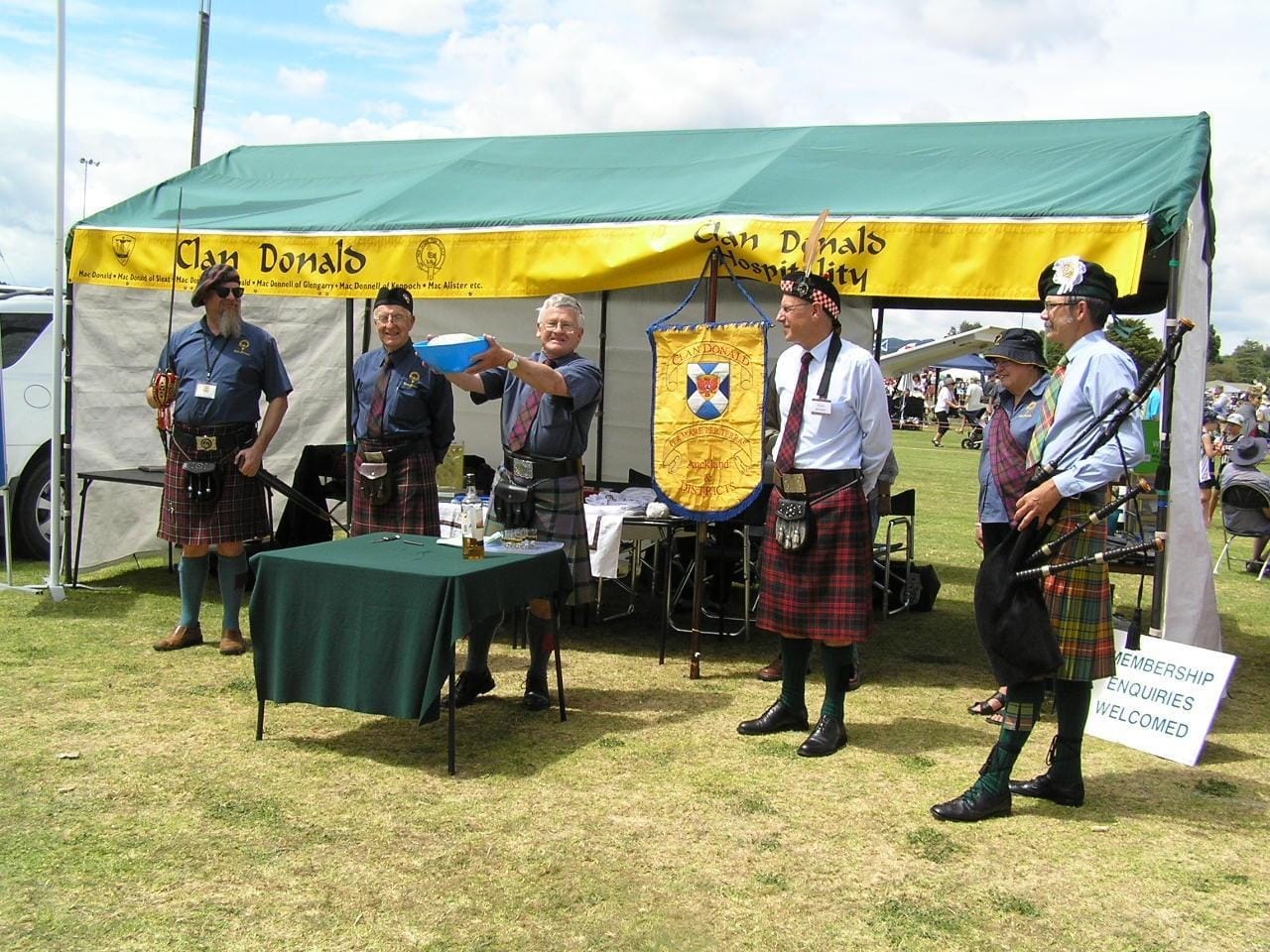
Clan tents are among the great—and sometimes underappreciated—resources at Scottish festivals.
Walk through the Clan Village. Introduce yourself. Tell the representatives what you know about your family.
Bring a few names and dates if you have them.
You may find someone who can explain the clan’s history, associated surnames, genealogy resources, tartans and membership organization.
For example, the Maine Highland Games typically hosts 40–50 clans and Scottish societies in its Clan Village. The New Hampshire Highland Games & Festival is another major gathering of Scottish culture in the region.
Scots in New England’s goal is to make these connections easier. Our Societies & Organizations resources and other directories can help you find Scottish organizations throughout our six-state region.
And if you cannot find your clan in New England, contact us. We may be able to help point you in the right direction.
8. What About My Clan Tartan?
Finding the clan often leads immediately to another question:
“So which tartan is mine?”
Here again, proceed carefully.
A clan may have several tartans associated with it—modern, ancient, hunting, dress and other variations. Some of those labels reflect comparatively modern textile conventions rather than ancient distinctions.
And tartans aren’t limited to clans. There are tartans associated with districts, military units, organizations, commemorations, corporations and individuals.
The authoritative place to investigate tartans is the Scottish Register of Tartans, maintained by National Records of Scotland. Its searchable database contains thousands of tartan designs.
Interestingly, Scottish custom is considerably less restrictive than many people assume. The Standing Council of Scottish Chiefs notes that there are no strict rules governing who may wear a particular tartan, although people traditionally choose a tartan associated with their surname or a district connected to their family.
So don’t worry about the imaginary “tartan police.”
But if you want your tartan to represent genuine family history, research first and buy second.
Scots in New England also has our own Guide to Scottish Tartans.
9. DNA Can Help, but…
DNA Doesn’t Simply Tell You Your Clan
DNA testing has become an important genealogical tool, particularly when combined with traditional documentary research.
But be cautious about claims that DNA can simply announce:
“You are Clan MacGregor.”
Clan identity developed through history, kinship, geography and allegiance—not solely through genetics. Large historic clans could contain people with different biological origins, while people sharing a distant biological ancestor could eventually belong to different communities.
DNA is therefore best used as evidence within a larger investigation, particularly for identifying genetic cousins and testing theories about particular family lines.
Think of DNA as another clue—not a substitute for genealogy.
10. Don’t Forget the Women in Your Family Tree
This is especially important.
Suppose your surname is Brown and you find no obvious clan connection.
That doesn’t mean you don’t have one.
Your paternal grandmother might have been a MacKenzie. Your great-grandmother might have been a Campbell. Another great-grandmother might have been a Fraser.
Within only five generations, you can have dozens of ancestral surnames.
Your Scottish heritage does not travel exclusively through the surname you happen to carry today.
Explore every branch of the tree.
You may discover several Scottish families—and several legitimate connections to Scotland’s clan history.
11. So Which Clan Is “My” Clan?
Sometimes there isn’t one simple answer.
You may discover ancestry connected with several Scottish families. One line may lead to the Highlands, another to the Borders and another to Glasgow or the Lowlands with no historical clan affiliation at all.
That’s perfectly good Scottish history.
Remember:
Being Scottish does not require belonging to a clan.
The Standing Council of Scottish Chiefs specifically cautions that Scotland historically contained many families and name-groups beyond the clan system.
The objective isn’t to acquire a romantic clan identity.
The objective is to discover your family’s actual Scottish story.
And the real story is usually more interesting.
Your Seven-Step Clan Hunt
If you’re ready to begin, here’s the Scots in New England method:
1. Start with yourself. Write down your parents and grandparents.
2. Record every surname. Include maiden names and collateral family lines.
3. Identify your Scottish immigrant ancestor or ancestors.
4. Trace them into Scotland using documents, particularly Scotland’s People.
5. Investigate possible clan or family associations using reliable clan organizations and the Standing Council of Scottish Chiefs.
6. Identify the appropriate tartan through the Scottish Register of Tartans and the clan’s own organization.
7. Make it personal. Visit a clan tent, contact the association, attend a gathering and consider joining.
Because genealogy becomes much more interesting when the names on the page become people, places and community.
Your Clan May Be Waiting for You
Perhaps the best part of discovering a Scottish clan isn’t finding a tartan.
It is finding people.
The clan system belongs to history, but clan associations today can offer friendship, genealogy, gatherings, newsletters, educational programs, trips to Scotland, Highland Games and opportunities to preserve Scottish heritage for another generation.
A search that begins with an old surname on your grandmother’s marriage certificate might eventually lead you to a tiny Scottish parish, an ancestral castle, a Highland Games clan tent—or distant cousins you never knew existed.
And you don’t need to know everything before you begin.
Start with a name.
Follow the evidence.
Ask questions.
Visit the clan tents.
Meet the people.
You may be surprised where the journey takes you.
Scots in New England Can Help
Scots in New England exists to connect people with the extraordinary Scottish cultural community throughout Massachusetts, Maine, New Hampshire, Vermont, Rhode Island and Connecticut.
Explore our Genealogy resources, our Scottish societies and organizations and our growing collection of Scottish history and cultural resources.
Have a clan connection or represent a clan organization in New England? We want to hear from you. Help us build an even stronger network connecting New England’s Scots, clan societies and Scottish families.