STARTING A SCOTTISH CLAN ASSOCIATION IN NEW ENGLAND


A Practical Guide to Bringing Your Clan Together Prepared for the Scottish community of New England
By Larry Bethune, Editor-in-Chief, Scots in New England
Across New England are thousands of people who identify with a Scottish clan or family but may have no local clan organization through which to connect with one another. Starting a clan association—or a New England branch of an existing association—can turn that shared heritage into a living community.
It does not require hundreds of members, a large treasury, or an elaborate organization. It begins with a handful of people who share an enthusiasm for their clan and a willingness to bring others together.
The objective is simple:
Preserve the heritage. Find the people. Bring them together. Pass it forward.
1. FIRST, FIND OUT WHAT ALREADY EXISTS
Before creating anything new, research your clan’s existing organization.
Many Scottish clans already have national, North American, international, or worldwide societies. More than 300 Scottish clan and family organizations are represented in one major online compilation, so there is a good possibility that your clan already has an organization somewhere.
Determine:
Does your clan have a recognized Chief or Commander?
Is there an international or Scottish clan society?
Is there already a North American or United States organization?
Does that organization have regional commissioners, conveners, chapters, or branches?
Is anyone already representing the clan in New England?
If a larger society already exists, contact it before establishing an independent organization. It may be far easier—and more beneficial—to create an official New England chapter, branch, region, or convenership under its umbrella.
The Council of Scottish Clans & Associations (COSCA) maintains information about clan and family societies and can be an important starting point.
2. DEFINE WHY YOUR ASSOCIATION SHOULD EXIST
Do not begin with bylaws and officers.
Begin with purpose.
Ask your first group of organizers:
What could we accomplish together that none of us can accomplish alone?
A good clan association might exist to:
- bring clan members and descendants together;
- preserve and teach clan history;
- encourage genealogical research;
- introduce people to their Scottish ancestry;
- participate in Highland Games and Scottish festivals;
- maintain relationships with the clan in Scotland;
- educate people about tartans, heraldry, traditions, lands and history;
- organize social gatherings, dinners, lectures and trips;
- welcome younger generations into the heritage; and
- create friendships and a sense of belonging.
A simple mission might be:
“The Clan ______ Association of New England brings together members, descendants, families and friends of Clan ______ to celebrate our shared heritage, encourage genealogy and education, build friendships, and preserve our clan traditions for future generations.”
That is enough to get started.
3. FIND FIVE TO TEN PEOPLE
You do not need 100 members to launch a clan organization.
Find five to ten enthusiastic people.
Look for them through:
- existing clan societies;
- Highland Games and Scottish festivals;
- Scottish cultural organizations;
- genealogy groups;
- Facebook and other social media;
- Scottish churches, cultural programs and events;
- family-history websites;
- local historical and genealogical societies; and
- friends and relatives.
Create a simple announcement:
Are You a ______?
We are exploring the creation of a Clan ______ Association in New England.
Whether you bear the clan name, descend from the clan or simply have an interest in its history and heritage, we’d like to hear from you.
Then collect names, email addresses, towns and states.
Do not make the initial process complicated. Your first goal is simply to discover whether there is a community waiting to be connected.
4. HOLD A FOUNDING GATHERING
Invite everyone you have identified to an informal meeting.
Make it enjoyable.
Meet at a home, library, Scottish pub, community center, Highland Games, restaurant or by Zoom.
The agenda can be remarkably simple:
- Introductions
- Why are we interested in the clan?
- What organization already exists?
- What would we like a New England organization to do?
- What activities sound enjoyable?
- Who else should we invite?
- What should we do next?
Do not spend the entire first meeting discussing constitutions and bylaws.
Talk about people, heritage and possibilities.
End by agreeing upon one enjoyable next activity.
5. DECIDE WHAT KIND OF ORGANIZATION YOU NEED
There are several possibilities.
Informal Clan Group
A small group can simply meet several times a year, maintain an email list and gather at Highland Games.
This is often the best way to begin.
New England Chapter or Branch
If your clan already has a national organization, ask about becoming its recognized New England chapter or region.
This may provide an existing membership system, insurance, publications, genealogy resources, leadership structure, logo and relationship with the clan leadership.
Independent Association
If no appropriate organization exists, you may eventually establish an independent association.
At that point you should consider bylaws, officers, banking, insurance, incorporation and potentially nonprofit/tax-exempt status. Obtain appropriate legal and accounting advice before establishing a formal nonprofit organization.
Do not create bureaucracy before you create community.
6. MAKE MEMBERSHIP WELCOMING
One of the first questions newcomers ask is:
“Do I have to have the clan surname?”
Not necessarily.
Membership policies vary among clan societies. Some welcome people bearing the surname, descendants through either maternal or paternal lines, associated families or septs, spouses and people with a genuine interest in the clan.
For example, the Clan Campbell Society (North America) expressly includes Campbells, descendants, recognized sept descendants, spouses and people interested in Clan Campbell and Scottish history and culture.
Your association should determine its own membership qualifications in consultation with any parent clan organization.
Whenever possible, think broadly about belonging rather than exclusion.
Someone whose grandmother belonged to the clan may feel every bit as connected to the heritage as someone who bears the surname.
7. GIVE PEOPLE SOMETHING TO DO
People rarely remain members simply because an organization has meetings.
They remain because something happens.
A successful New England clan association might offer:
Social activities: ceilidhs, dinners, picnics, Burns celebrations and informal gatherings.
Genealogy: workshops, family-tree projects, DNA discussions, research assistance and opportunities for members to share discoveries.
Clan education: presentations about clan history, chiefs, castles, battles, migrations, notable members, tartans and traditions.
Highland Games: establish a clan tent and create a welcoming gathering place for members and visitors.
Scottish travel: organize or participate in trips to clan lands, castles, gatherings and historic sites in Scotland.
Youth and families: create activities that allow children and grandchildren to discover the heritage.
Service: participate together in community or charitable activities.
The test should always be:
Would I look forward to attending this?
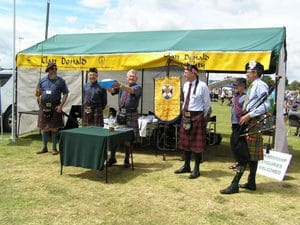
8. MAKE THE CLAN TENT YOUR FRONT DOOR
For a New England clan organization, Highland Games and Scottish festivals can become one of your most effective recruitment opportunities.
Your tent does not have to be elaborate.
Start with:
- clan banner;
- tartan;
- maps of clan lands;
- photographs;
- brief clan history;
- genealogy information;
- associated surnames or sept information where historically appropriate;
- membership information;
- QR code;
- email signup sheet; and
- several friendly people.
Most importantly:
Stand in front of the table—not behind it.
Talk with people.
Ask:
“Do you have a connection with our clan?”
Someone walking into your tent knowing almost nothing about their ancestry may eventually become one of your association’s strongest members.
9. BUILD A SIMPLE COMMUNICATION SYSTEM
Initially you need only:
An email address
Something such as clan____newengland@…
An email list
Your most important organizational asset may eventually be your contact list.
A simple web presence
Start with a page or basic website explaining who you are, your clan, upcoming activities and how to join.
Social media
Use it to share photographs, history, genealogy discoveries and events—not merely announcements of meetings.
Eventually consider an electronic newsletter.
Every communication should provide an obvious answer to:
“How can I become involved?”
10. CREATE JUST ENOUGH ORGANIZATION
Once the group has demonstrated that it can attract and retain participants, establish the structure necessary to sustain it.
A simple leadership team might include:
President or Convener — provides leadership and represents the association.
Vice President/Deputy Convener — assists and develops programs.
Secretary — maintains records and communications.
Treasurer — manages finances.
Membership/Genealogy Coordinator — welcomes members and assists with clan connections.
Games Coordinator — organizes tents and festival participation.
You may eventually adopt bylaws covering purpose, membership, officers, elections, meetings, finances, committees and dissolution.
Established societies can provide useful models. Clan Campbell Society (North America), for example, publishes bylaws covering organizational purpose, membership categories, meetings, officers and governance.
But remember:
The structure exists to serve the clan community. The community does not exist to serve the structure.
11. CONNECT WITH THE LARGER SCOTTISH COMMUNITY
A clan association should not become an island.
Introduce your organization to:
- your national or international clan society;
- your clan Chief, Commander or appropriate representative when applicable;
- neighboring clan associations;
- Highland Games organizers;
- Scottish cultural organizations;
- genealogical societies;
- libraries and historical organizations; and
- other Scottish organizations throughout New England.
COSCA exists specifically to support Scottish clan, family and heritage organizations and provides resources concerning governance, membership, genealogy, Highland Games, technology, nonprofit management and organizational development.
Collaboration can make a small organization much stronger.
12. THINK ABOUT THE NEXT GENERATION FROM DAY ONE
The ultimate measure of success is not how many meetings you hold.
It is whether someone is prepared to carry the heritage forward after you.
Invite younger members onto committees. Give them genuine responsibilities. Use technology. Welcome families. Create activities rather than endless business meetings. Record oral histories. Digitize photographs and documents. Encourage genealogy. Develop relationships with Scotland.
Most importantly, make participation enjoyable.
Heritage survives because people find meaning, friendship and belonging within it.
YOUR FIRST 90 DAYS
Month One — Discover
Research the existing clan organization.
Contact its leadership.
Identify five to ten interested people.
Create an email/contact list.
Month Two — Gather
Hold an informal gathering.
Discuss what members want.
Choose a temporary coordinator.
Plan one enjoyable activity.
Month Three — Appear
Attend a Scottish event together.
Create a basic webpage or social-media presence.
Begin planning a clan tent at a New England Highland Games.
Invite another ten people.
Then keep going.
THE MOST IMPORTANT ADVICE
You are not really starting an organization.
You are finding people who already share a heritage and giving them a way to find one another.
The paperwork can come later.
Start with five people around a table. Tell stories. Compare family histories. unfold the tartan. Find the clan lands on a map. Plan your first gathering.
Then invite someone else.
That is how a clan community begins again.
Preserve the Heritage.
Find the Family.
Build the Community.
Pass It Forward.