WHY JOIN A SCOTTISH CLAN?

Heritage, Friendship, Discovery and a Lot More Fun Than You Might Expect
By Larry Bethune, Editor-in-Chief, Scots in New England
You don’t need to own a kilt. You don’t need to know your genealogy back to the 1600s. And you certainly don’t need to know the difference between a strathspey and a reel.
You just need to be curious.
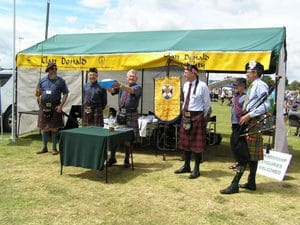
If you’ve ever attended a Highland Games or Scottish festival in New England, you’ve probably seen them: rows of colorful tents displaying tartans, banners, coats of arms, maps and mysterious Scottish names.
Perhaps you’ve walked past and wondered: Is one of these my clan? And if it is, what exactly am I supposed to do about it?
The answer may open the door to one of the most enjoyable ways of discovering Scotland in New England.
First of All: What Is a Clan Association?
Today’s Scottish clan associations aren’t medieval armies preparing to defend the glen. They are communities of people who share an interest in a clan, its history and the Scottish heritage surrounding it.
Some members have spent decades researching their ancestry. Others know little more than the surname of a Scottish grandparent. Some aren’t Scottish at all but have married into a clan family or simply developed a love of Scottish culture.
The common denominator isn’t expertise.
It’s interest.
And for many people, joining a clan association transforms Scottish heritage from something you read about into something you actually participate in.
Is It Fun?
Yes. Very much so.
Clan life can include Highland Games and festivals, ceilidhs, Burns Suppers, dinners, music, dancing, lectures, genealogy programs, trips, commemorations and informal gatherings.
At a Highland Games, there’s something special about walking into a clan tent and being greeted by people who are genuinely delighted that you stopped by.
You may arrive knowing nobody.
A half hour later, you may be comparing family names, looking at maps of Scotland, hearing stories, discovering which tartan belongs to whom—and being introduced to people you didn’t know were distant cousins.
Children can discover that history isn’t confined to textbooks. There are pipes to hear, Highland athletes to watch, tartans to identify and stories of castles, migrations and remarkable ancestors to explore.
For young adults, clans can offer something increasingly valuable: a community built around shared identity and experience rather than an algorithm.
And for adults of every age, there is simply the pleasure of meeting interesting people and enjoying Scottish culture together.
Will I Learn Something?
Almost certainly.
Join a clan and you may find yourself learning about Scottish geography, history, genealogy, migration, music, language, clothing, customs and traditions—often without feeling as though you’re “studying” anything.
You might discover why your ancestors left Scotland and why so many eventually came to New England.
You might learn that your surname has several spellings—or that another surname in your family is traditionally associated with the same clan.
You might discover the region of Scotland connected with your family, learn about the clan chief, identify a tartan, or begin tracing your family tree.
And sometimes one conversation at a clan tent can provide the clue that sends a genealogical search in an entirely new direction.
Scottish history becomes personal when you begin discovering where you fit into it.
Do I Have to Prove I’m Related?
This is one of the biggest misconceptions about Scottish clans.
In many cases, no elaborate genealogical proof is required to participate in or join a modern clan association.
Individual organizations establish their own membership rules, but many welcome people connected through clan surnames, associated names or septs, marriage and family relationships. Some also offer associate memberships to people who simply support the clan and its heritage.
So don’t decide that you “don’t qualify” before asking.
Walk into the tent – Introduce yourself – Tell them what you know.
Even if it isn’t much, that’s a perfectly good place to begin.
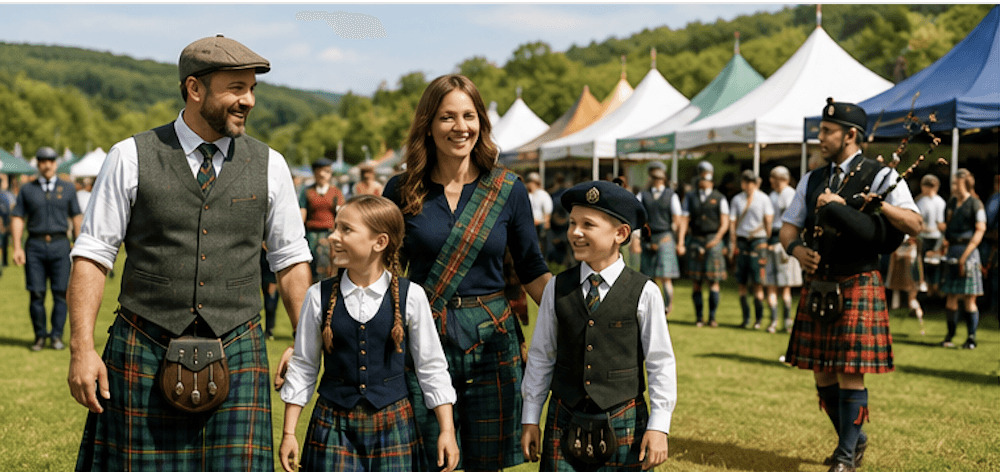
A Great Experience for Families

Clan involvement can be particularly rewarding for families because it gives children and grandchildren something that a family tree alone cannot provide: an experience of heritage.
A child may not become excited by hearing that a great-great-great-grandparent came from Argyll.
But take that same child to a Highland Games, show them the clan tartan, let them hear hundreds of pipers, watch the caber toss, visit their clan tent and meet people wearing the same tartan—and suddenly Scotland isn’t just a place on a map.
It becomes part of their story.
That is how heritage survives: one generation sharing it with the next.
Something for Young Adults, Too
Scottish heritage doesn’t have to be old-fashioned.
Genealogy is increasingly digital. Clan communities connect through websites and social media. Young pipers, drummers, dancers, musicians and Highland athletes are carrying traditions forward while putting their own stamp on them.
And you don’t have to approach Scottish identity solemnly.
Wear the tartan. Learn the stories. Go to a concert. Try Highland dancing. Attend a ceilidh. Volunteer at a festival. Research an ancestor. Learn a few words of Gaelic or Scots. Meet people your age who share the interest.
Heritage remains alive precisely because every generation makes it its own.
More Than History
Perhaps the greatest benefit of joining a clan association isn’t something you’ll find in a genealogy database.
It’s belonging.
The original clans were communities built around kinship, loyalty and shared identity. Modern clan associations are obviously very different, but something of that human impulse remains.
People gather.
Friendships form.
Older members share what they know with younger members. Newcomers become regulars. Families return to the same Games year after year. People who began as strangers find themselves working together behind a clan tent.
You may initially join because you’re interested in someone who lived in Scotland 250 years ago.
You may stay because of the people you met last Saturday.
Start at the Clan Tents
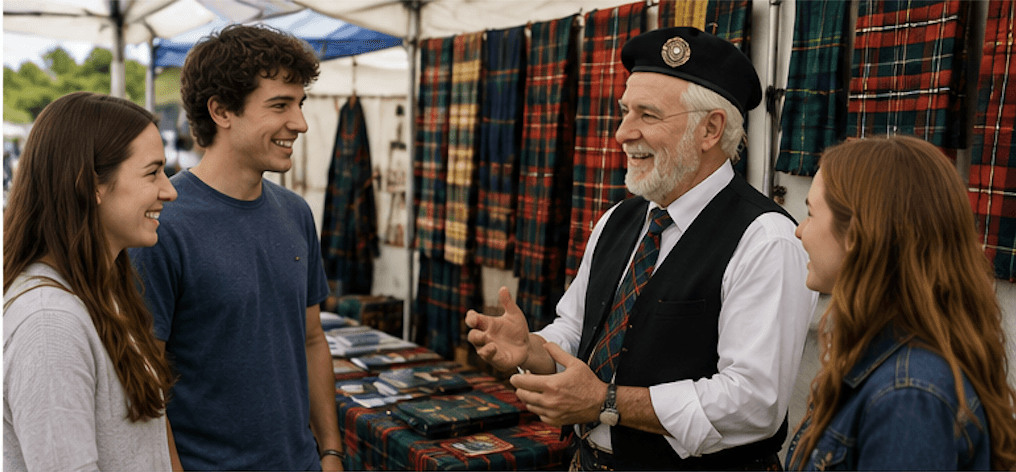
If you’re attending your first Highland Games or Scottish festival, don’t just admire the clan tents from a distance.
Go inside.
Ask questions.
Try something as simple as:
“I think my family may be connected with this clan. How would I find out?”
You don’t need to know the right terminology. You don’t need a pedigree. And you don’t need to buy anything.
Clan representatives are there precisely because they want to meet people who are interested.
And if you don’t know your clan yet, that’s all right too.
Finding it can be part of the adventure.
Let Scots in New England Help You Find Your Clan
Scots in New England connects Scots, Scottish-Americans and friends of Scotland throughout Massachusetts, Maine, New Hampshire, Vermont, Rhode Island and Connecticut.
One of our goals is to make it easier for people to move from “I wonder if I’m Scottish?” to “I found my clan!”—and from there to becoming part of the wider Scottish community.
Through our clan resources, genealogy information, Highland Games coverage, Scottish organizations and growing Find Your Clan in New England resources, we want to help make that first connection easier.
Because Scottish heritage shouldn’t simply be preserved behind glass.
It should be discovered, shared, celebrated—and enjoyed.
DISCOVER SCOTLAND IN NEW ENGLAND
Find Your Clan. Find an Event. Explore Your Heritage. Meet Your Scottish Community.
Whether you’re bringing your children to their first Highland Games, beginning your first genealogy search, looking for your family’s tartan, or simply wondering what all those clan tents are about, come explore.