SCOTLAND WAS ON FIRE 🔥 IN BOSTON
FIFA World Cup 2026
by Rory Hallowell, Scots in New England
Contributions by Michael Inglis, Alex Patnod, and Larry Bethune – STAFF

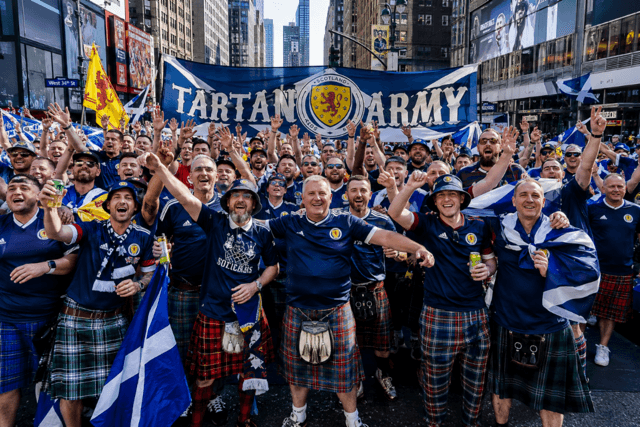
The Tartan army didn’t merely visit Boston, but graced us with a Scottish charm and energy we had long desired. Since the Scot’s migration down south to Miami and back across the pond, Bostonians have repeatedly expressed a desire for a reunion with the Scots. Cones still adorn the tops of our precious statues, and a little known adapted eurovision song Freed by Desire by Italian singer Gala, “Scotland’s On Fire”, has played in the back of our minds on repeat as it did in our bars and streets late into the night. Statistics, music, social media impressions and attendance figures can hardly explain fully what happened in and to our city. No doubt, the Tartan Army’s visit to Boston is worth an expansive recap.
Reports indicate that no fewer than 50,000 Scots were in New England and Florida for the World Cup games. Our usually quiet and reserved city, Boston, undoubtedly became the loudest it has been since the Revolution just 250 years ago. The music and chanting were unignorable – felt from Providence, Rhode Island to Jamaica Plain, Downtown crossing and northward towards the New Hampshire Coast. One particular and musical engagement occurred when Scots seemingly took over a Boston harbor cruise, and their cheers no doubt could be heard from all corners of Boston Harbor. Many noted on social media that the city had seemed to surrender itself to a Scottish festival we never knew we needed, wanted or would have.
The lively atmosphere was not merely felt by those fortunate enough to witness it in person. Social media played a pivotal role in rallying Bostonians to party among the Scots. Videos of the harbor cruise for example- a boat filled to the brim with tartans and cheer- quickly garnered tens of thousands if not millions of views. To put it plainly, the Scots went viral, and their infamy on social media began in Scottish airports, with videos of the tartan army boarding planes as though it were a school trip to D.C. One of the first truly viral moments came about as soon as the Scots landed at Boston Logan, where interviews suggested the Scots had “drunk the planes dry”, a hint at what was soon to come. Before the first ball had even been kicked at Foxborough, the Tartan army had already become an extraordinary and unignorable spectacle of the city.
Soon after arriving, Scots all around Boston went viral immediately. One Bostonian reported that the Scots who had moved into an Airbnb next door had woken all manner of people and animals in the neighborhood up early one morning with bagpipes and cheer. Soon after, a friendship was formed, with the Scots gifting bottles of scotch to one Bostonian neighbor.
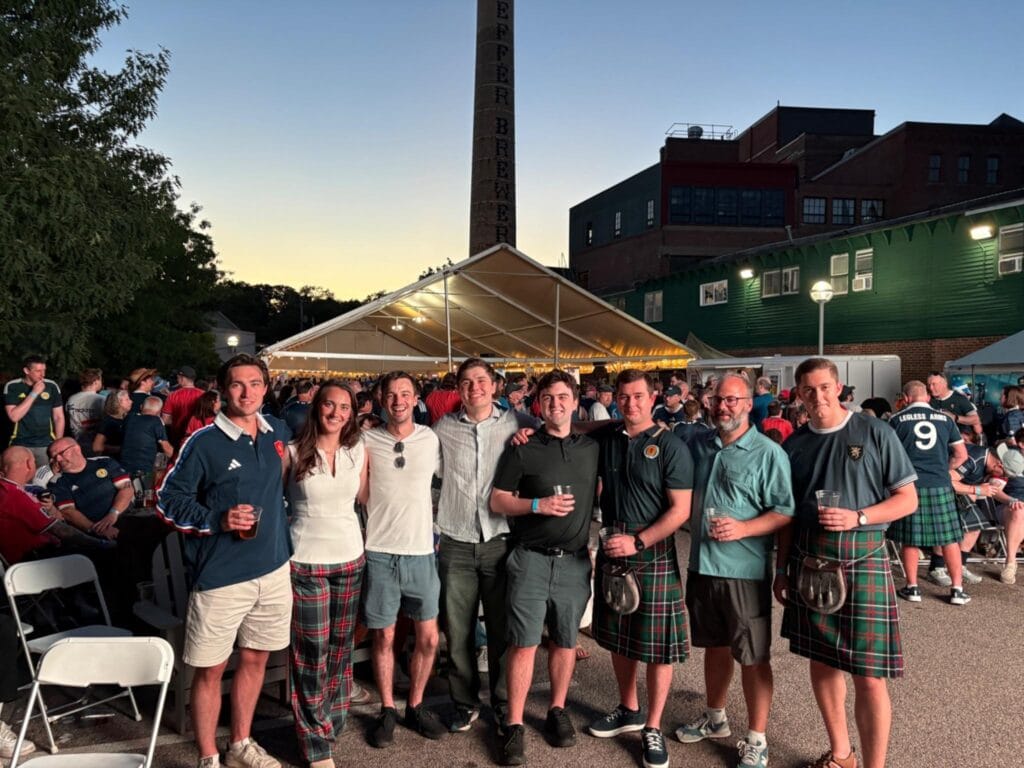
As stories like these quickly multiplied on social media, curiosity quickly led-into active participation. We can speak for all at New England Scots when saying that our phones “blew up”. At first, we received texts asking about the Scots, wondering if we knew where they would be, and whether this watch party or that one would be an ideal opportunity to participate. The Tartan army were tartan clad in almost every bar on every street in the city. They were impossible to ignore. No watch party was left ungraced by their presence, music, and cheer; no bar was left lonely.
Though an unusual spectacle for most Bostonians, the Tartan Army were welcomed here as though they had always belonged, and indeed, they always have. News agencies began reporting within a few days of their arrival that the Tartan army had drunk all the beer in Boston. Guinness USA posted a photo on instagram of a Guinness-can-styled semi-truck on the Zakim Bridge, entering the heart of Boston to reinforce the bars. We love Guinness.
White Claw, a popular hard-seltzer company that took advantage of the ordeal by sending representatives to Boston with “claws”. These representatives gave the fruity seltzers to Scots during this “beer shortage” and interviewed them regarding whether they liked the beverage or not. The Scots were generous.
It has often been said that Bostonians can drink, and while the Scots may have tested our beer supplies, it is hardly believable that as a city we “ran out of beer:, despite far exceeding St. Patrick’s day sales. Certainly, this might have occurred in a few pubs and bars. Whether Boston was truly “drunk dry” is irrelevant in the sense that such a story well encapsulates the energy and exuberance of Boston’s wild week with the Scots. It doesn’t matter whether we really did run out of beer; we had cheer and spirit that drove long nights into head-aching mornings.
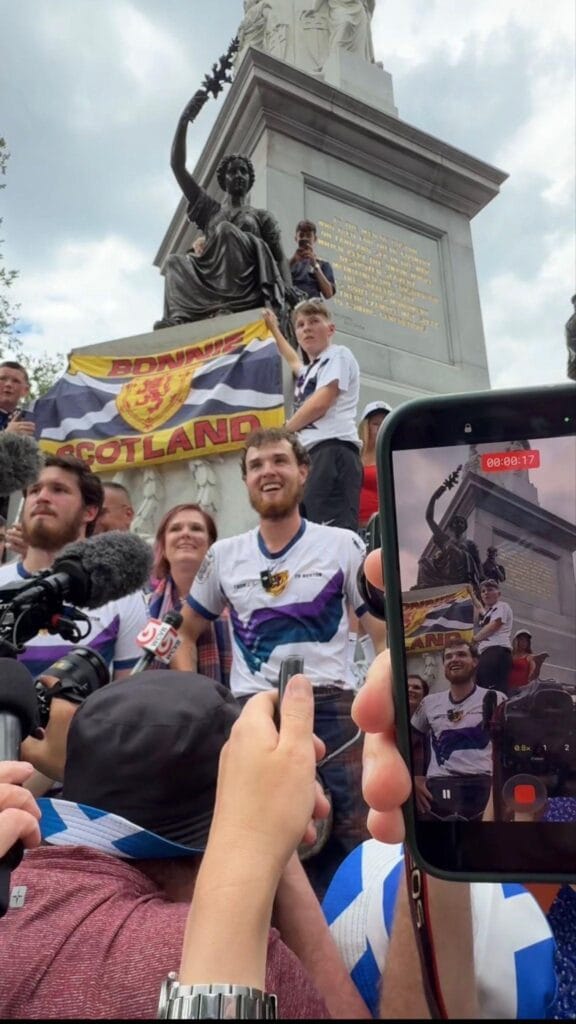
Festivities were limited to neither song nor drink; the Tartan army introduced Bostonians to stranger traditions that the city may hold dear for years to come. “Coning” as it has been called, is the tradition of Scots putting traffic cones atop statues – with mercy provided to those statues Scots deemed unfit for coning. The poor Duke of Wellington, who famously defeated Napoleon at Waterloo, wears a cone permanently on his statue outside Glasgow’s Gallery of Modern Art, where the tradition originates. To most Bostonians, this tradition was profoundly absurd with some noting it as nearly offensive. To the Scots, coning Boston’s statues was a way of inviting strangers into their ongoing joke. To say the least, the joke was well received. An official cone was sent via plane to Boston, with Governor Maura Healey receiving the cone at Boston’s Logan airport, as though the cone were an important diplomat.
What began as an irregular and seemingly spontaneous festival of song, cheer, beer and dance soon made its way into the usually reserved halls of American government; Bay State politicians quickly took note of the Tartan Army’s warm reception by the people of Boston. Mayor Wu participated in the “coning” tradition outside Boston’s city hall, and Governor Maura Healey poured pints at the Dubliner on Central Plaza. Healey went a step further, meeting in the State House with Scottish super fan Craig Ferguson. Ferguson went viral soon after arriving in Boston, having walked to the city from Los Angeles, raising over a million pounds for mental health charities. At their publicized meeting, Healey pretended to legalize Haggis through a written executive order- a cruel joke to New England Scots who have wanted to “free the haggis” for decades. Days later, Healey revealed on social media that she had been advised against legalizing haggis, and that the executive order was in fact nothing more than a ruse.
Social media definitely played a monumental role in introducing Boston to the Tartan Army, but it also transformed ordinary gatherings into legendary citywide events and cultural experiences. On June 16th and in the basement of the Massachusetts State House, we received texts regarding a soon to be viral post by Giovanni Piacentini-Smith, a Scottish fan and influencer with the Tartan Army. Giovanni petitioned his followers and viewers alike to meet the very next day in the Boston Common for an Irn-Bru meetup. For those who don’t know, Irn-Bru is a Scottish, orange flavored energy/soft-drink, and Giovanni sought to organize a world record Irn-Bru meetup. Hundreds of fans and Bostonians joined him the following day, trying the famous Scottish drink the Boston common.
Scots in New England has taken note of Irn Bru’s success here, and we will soon publish information for those wishing to indulge, regarding exactly where one can find Irn Bru in New England. We will also be publishing a “Scottish & British Grocery Guide to New England (2026)”
Other influencers like Scot’s in New England contributor Iona MacGowan (found @ Instaiona) joined on social media, posting about Scottish activities throughout the city, and encouraging Bostonians to join in on the fun. Iona wrote of the festivities For a lot of people, Scotland has always been something they admire from a distance… all kilts, castles and wee shortbread tins. What the World Cup did was let Boston experience the real Scotland: the banter, the warmth, and the ability to turn absolutely anything into a good time. Most importantly, the Tartan Army didn’t just put on a show for people to watch. They invited everyone in and made them part of it, creating a connection that will last for generations.” To say the least, the Tartan Army turned Scottishness into something that no longer had to be observed from outside or within a bar, but something outsiders and observers from abroad could enjoy.
Perhaps the legacy of the Tartan Army will be of a tree bearing fruits that far outlast the tournament itself. With the extraordinary and then ongoing love affair between Boston and the Tartan Army who were taking over the city, Massachusetts politicians sought new relationships with our friends across the pond. Mayor Wu has announced plans for the formal establishment of a sister-city relationship with Glasgow, and the Glaswegian Lord Provost is expected to visit Boston soon. The charitable contributions of the Tartan Army no doubt played a role in winning New England’s heart, with the Tartan army pledging nearly $30,000 to various programs in Rhode Island, not to mention the tens of millions of dollars injected in beer-dollars and hospitality services between Massachusetts and Rhode Island.
Change is hard. The festive documentation of the Tartan Army on social media has changed, with Bostonians posting pictures of cones left behind, and even stories of jealousy towards Miami who would host them next. The songs have quieted and kilts have returned across the pond. Eventually, the traffic cones will come down. What remains however is something far more enduring: the legacy of an energy felt in Boston the likes of which maybe we haven’t known since the Revolution, 250 years ago. In this case, we forged international friendships cultivated neither by treaty nor diplomacy, but by ordinary people who crossed the Atlantic carrying more than tartan adorned kilts, but good humor, a thirst for beer, the cheer of song, and an open invitation for Bostonians to join-in on the Scottish celebration. We will never forget the fun we had that week. Boston was a blast!

Hear BBC Radio Scotland’s interviews with Scots in New England’s president Bob Creighton and vice-president/editor-in-chief Larry Bethune recorded in advance of the Games.
Bob Creighton interview BBC Radio Scotland
Larry Bethune interview BBC Radio Scotland
Audio interviews courtesy of BBC Radio Scotland
The future, getting in touch with Scots in New England, how people can continue to participate in Scottishness in Boston, events, pubs, etc.. How to find YOUR TARTAN, and YOUR CLAN. We are here for this purpose exactly, so don’t say think this is over… you can find the afterglow and supporters of your beloved Tartan Army right here in New England.